
Home  /  About

About Us

Our Story

Taskscape was established to answer a question.

How can values-led people keep pace and connect with a fast-changing world, while they’re busy working to understand and improve it?

This occupied Taskscape’s founder while at the forefront of the digital revolution at the BBC.

Since then, Taskscape has supported a wide range of initiatives and organisations in reimagining, delivering and communicating work that matters.

Our Specialisms

Combining flexibility with depth is our superpower.

  • Our Consultancy is strategic and advisory work, covering everything from communications-based operational audits to funding bid support and digital workflow design.
  • Real-world capture sits at the heart of our Content offer. Whether filming in remote environments or delivering targeted formats, we bring deep expertise in communicating complex topics in accessible and engaging ways.
  • Our Workflows are all about implementation, building out the platforms and content systems initiatives need, providing training, and embedding associates to add capacity from within.

We work across sectors, including on international projects funded by major grantmakers.

Our Core Team

Portrait of Alastair Simmons

Alastair Simmons

Founder & Director

Alastair spent over two decades at the BBC, largely as a producer and director of radio and television. Working across departments including Features, Religion & Ethics, and News, his credits range from producing Radio 4 documentaries to directing outside television broadcasts, including the BBC Anniversaries, Antiques Roadshow and music events like T in the Park.

More

Alastair went on to lead initiatives in corporate strategy and training, also working internationally, seconded to the UK Foreign & Commonwealth Office. While serving as Editor Music for BBC Scotland, he joined the leadership team managing the BBC’s move to Pacific Quay, Glasgow, with responsibility for future-proofing digital production.

Years spent watching teams and technology reshape each other inspired him to complete an MBA at Lancaster University Management School, where he specialised in strategic HRM, organisational behaviour change and social marketing. He founded Taskscape in 2006.
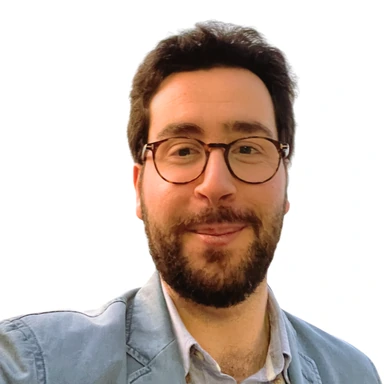
Portrait of Theo Simmons

Theo Simmons

Director

Theo has worked throughout Taskscape for over ten years in almost twenty countries. He started in 2015 as a content intern, crewing media roles from runner to producer-director, and building the company’s first website, helping modernise Taskscape’s formats, recruitment and workflows.

More

As an Associate, Theo then led teams and produced digital content hands-on for clients ranging from local heritage campaigns to international research projects. After completing a Bachelor’s in English at St John’s College, Oxford, he joined Taskscape full-time in 2020, expanding his work beyond content into client consultancy and project delivery.

Theo draws on experience in content marketing, web design, IT and responsible AI to help Taskscape and its clients thoughtfully deploy new technologies. Recently, he’s formalised this through professional development, including at Saïd Business School. Beyond Taskscape, he’s an independent filmmaker with projects screened at BAFTA-qualifying festivals.

20+ Years
30+ Countries
40+ Projects
Get in touch

FAQs

What about sustainability?

We work internationally, often for sustainably minded initiatives, which raises a classic paradox: does the benefit of the work we’re doing outweigh the travel emissions?

In order to help square that circle, we:

  • minimise and rationalise travel efficiently
  • prefer rail, hybrid and electric vehicles by default where viable
  • book flights with carbon credit and reforestation schemes (attempting to avoid greenwashing by asking scientists we know for recommendations)
  • increasingly work with in-country Associates, where suitable, to minimise travel emissions

Taskscape team members have undertaken sustainable production awareness training and, where possible, we’re guided by best-practice frameworks, such as those developed by BAFTA’s Albert and similar initiatives.

How do you work with Associates?

Taskscape contracts with a wide range of self-employed Associates on a per-project basis. Associates are vetted appropriately, some are regular collaborators, and all are chosen for their values, professionalism and abilities.

Because Associates work with us periodically as part of portfolio careers rather than continuously accepting all offered work, they aren’t employees. Nonetheless, we ensure all Associates on our projects receive:

  • Living Wage and BECTU minimums (geographically scoped)
  • Rest breaks and agreed limits on working time
  • Protection for complaints and against discrimination
  • Appropriate health and safety protections and agreed insurance
  • Written contracts, agreed expense and billing procedures
  • Complimentary mentoring, career advice and development (if early to mid-career, collaboratively designed on an individual basis)
  • References and credit details to evidence work on white-labelled outputs
What about widening access and participation?

Since 2006, we’ve developed relationships with a number of university courses, mainly in the North of the UK, to provide final-year students and recent graduates from socioeconomically disadvantaged backgrounds and rural areas with placements on Taskscape projects. These range from paid work experience and specific grant-funded schemes to Associate contracts. Past support has included Santander Universities.

We couldn’t be prouder of what the beneficiaries of these opportunities have gone on to achieve, from top-flight adventure filmmaking in the Himalayas to the Sound Department of Peaky Blinders.

Where did the name ‘Taskscape’ come from?

Our name and approach draw on the social anthropologist Tim Ingold’s idea of the ‘taskscape’. Like a landscape, a taskscape is an array of related activities people carry out as they live and work together in a shared context. It’s socially made and always in motion, less a fixed map than a pattern of work unfolding over time. By adapting the idea, we found a name and an inspiring framework for helping people navigate and share work that matters for the world.

Do you have social media?

It may seem odd that, as a communications-focused company, we don’t use social heavily. This is deliberate. We spend our time working for our clients and projects, rather than talking about ourselves. We’re happy to stand on the results we achieve for them. For two decades, we’ve been hired through people discovering our work, as well as referrals and repeat business. So our focus remains helping people navigate and cut through the noise rather than adding to it. You can explore past projects in the case studies section of this site and find many of our video outputs on Vimeo, linked in the footer.

How do you use AI?

We believe AI is a powerful tool to enhance skilled human work, not fully replace it. We use AI carefully and deliberately, including helping organisations think through where it fits responsibly within their own operations. Our focus is on safety and reliable results, avoiding hype without substance. We’ve used forms of AI since 2017 across our workflows and those we help clients and projects build. As with issues of travel (covered above), the environmental costs are significant, so use should bring real benefit to values-led initiatives, and mitigations should be sought where available.

Read our full Position Statement on AI

Where do you work?

Taskscape is based out of a well-connected corner of Northern England, with a network of Associates across the UK, Europe and beyond. We work on UK and international projects in roughly equal measure. Most engagements combine remote collaboration with targeted in-person fieldwork, filming or workshops, scoped to the project’s needs. We maintain backup media servers in different UK locations and are members of various spaces where we can meet or host clients and collaborators in London, Manchester and Edinburgh.

Taskscape is registered with the EU as an eligible consortium partner or project participant (PIC) and with the BBC as a production company eligible for commissions (PiCoS).